Overview
Multivendor Integration (MVI) is a Customer Specific activity. It allows vendors and their customers to successfully integrate multivendor networks. The process outlined here is only an example, but the principles can be applied to any given project.
MVI Definition
MVI is defined as the integration and verification of a customer-specific configuration in a multivendor environment. It is performed on the customer site or test bed in co-operation between the vendors and their customer, with a focus on end-to-end features and applications. It is a logical follow-on from IOT. It provides an agreed process that guarantees formal customer involvement with clearly defined roles and responsibilities.
Testing Environment & Scope
As MVI relates to customer-specific configurations, the test environment and scope of work will vary from project to project.
- Focus on customer-specific network configurations.
- Co-operation between vendors and the customer.
- Testing of end-to-end applications.
The MVI Process Flow
The MVI process generally consists of four main activities: project planning, test planning, testing, and test reporting, as depicted in the following diagram.
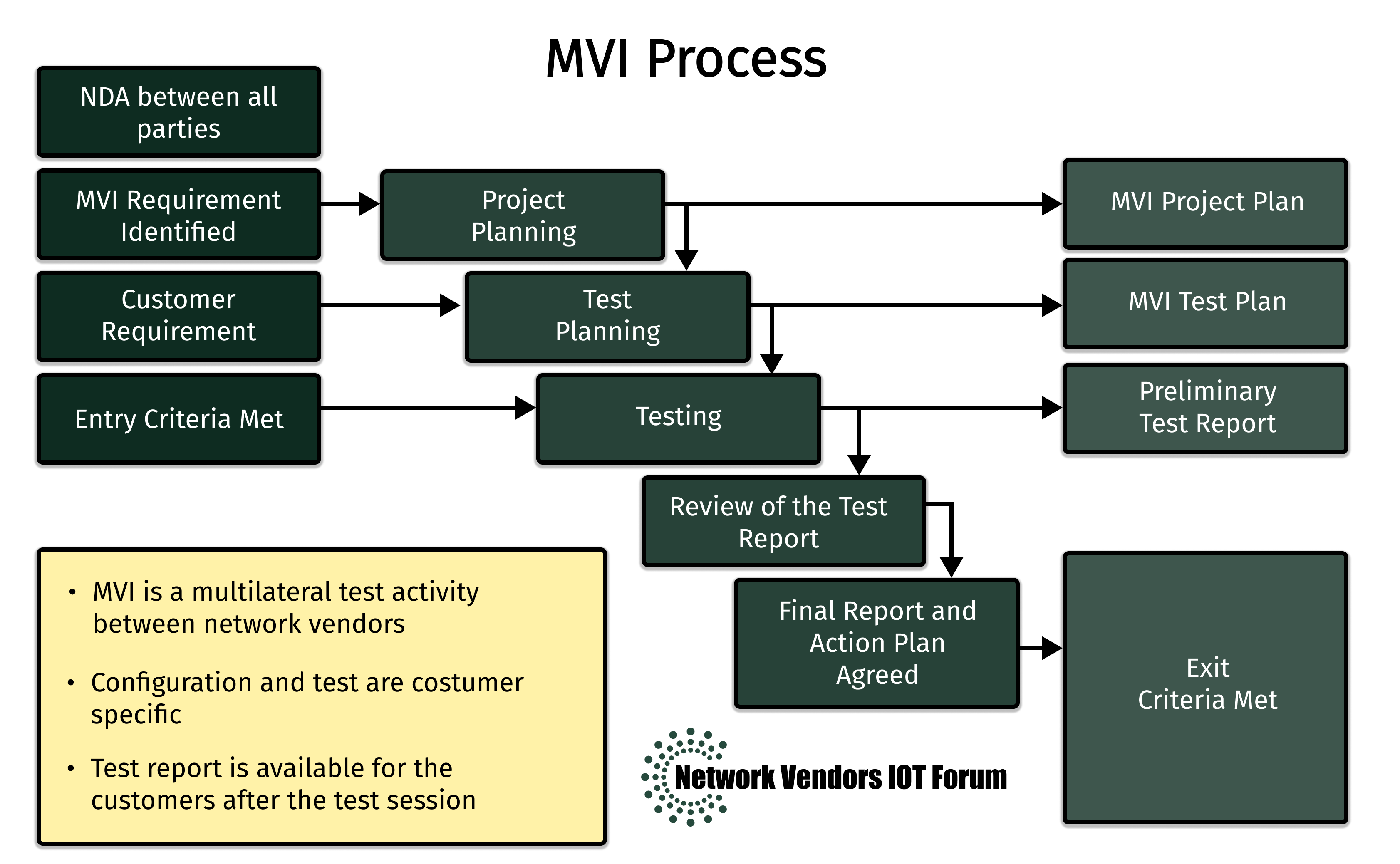
Project Planning
Involves the formation of a project planning group with representatives from the customer and all involved vendors. The outcome is a project plan containing software loads, schedules, and specific requirements.
Test Planning
Tests are agreed upon based on customer requirements and network capabilities. Configuration parameters are defined at this stage.
Test Reporting
A final report is produced. Testing is complete when all Exit Criteria have been met.