Overview
Interoperability Testing (IOT) allows vendors to bilaterally verify the standards-compliant interfaces between their network elements in a controlled environment using suitable test cases prior to software release in common operator networks. There are two types of IOT activities: Generic IOT (G-IOT) or Customer Specific IOT (MVI)
IOT Definition
IOT is defined as the bilateral activity between two vendors verifying an interface between their network elements, on a functional level, in accordance with the relevant standards.
Testing Environment & Scope
The elements under test are regarded as black boxes with well-defined external interfaces.
- Uses real network elements and mobile stations.
- Excluded: Conformance and stress testing.
- Pre-requisite: Internal integration.
The Generic IOT Process Workflow
The industry widely adopted IOT process defined by the NVIOT Forum consists of five main activities.
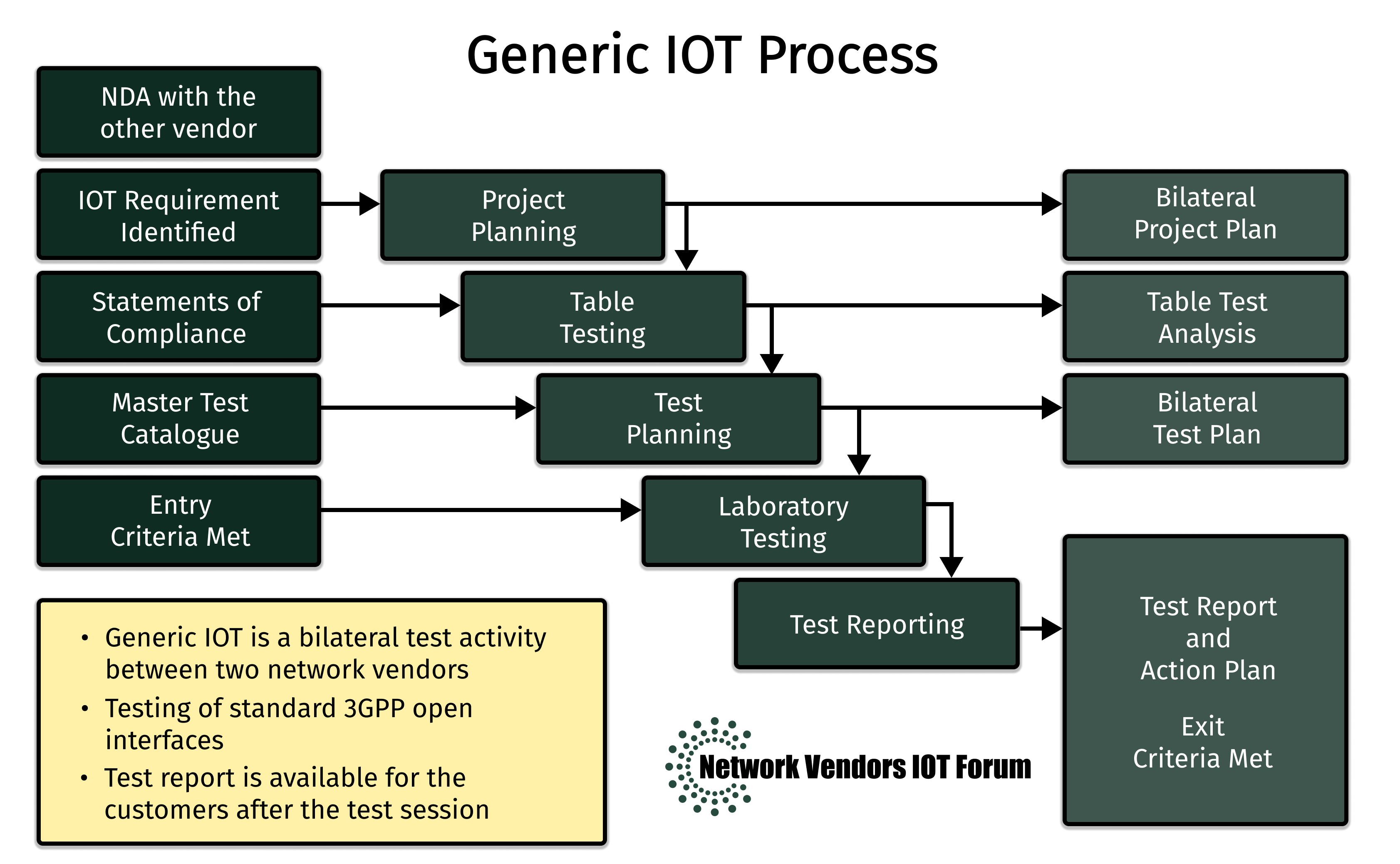
Project Planning
Vendors bilaterally agree on a project plan containing details of software loads to be tested.
Table Testing
Vendors exchange compliance statements to identify differences prior to the test phase.
Test Planning
Using the table test analysis, a list of test cases is prepared for laboratory testing.
Laboratory Testing
Actual testing takes place monitoring protocol interworking against cases.
Check Entry Criteria →Test Reporting
A joint test report is produced. Any outstanding issues result in an action plan. Testing is complete when exit criteria are met.
Check Exit Criteria →